
When Holly Creek resident Sandy Kappus first learned to embroider, knit, and crochet at eleven, she never would have imagined that needlepoint would become a prolific love later in her life. Nor could Sandy have dreamed that her creativity would become a public art display. But earlier this year, visitors to Holly Creek’s Silverton Art Gallery had the opportunity to explore over eighty individual pieces of needlepoint art, all created by Sandy herself.
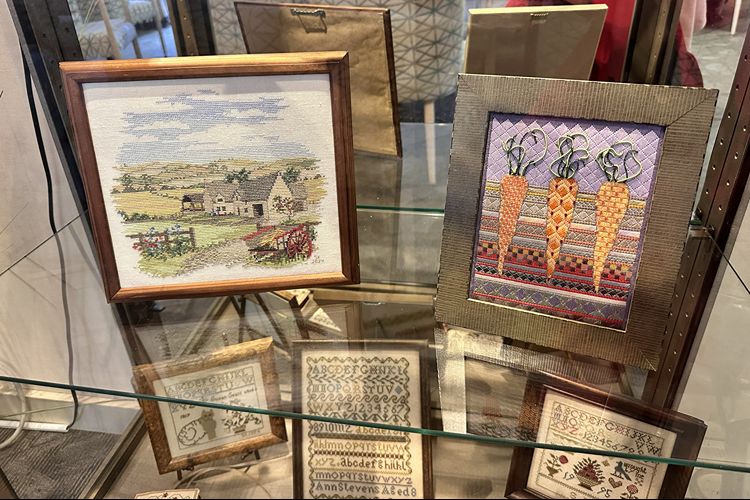
“I took up needlepoint in earnest after I retired in 1990,” she explained. “I belonged to three guilds: the American Needlepoint Guild, and the Embroiderers’ Guild of America, and a regional one that I helped to establish, the Sampler Guild of the Rockies. Each of the guilds offered three-year certifications, and the more intricate pieces that I have completed [and on display] were taught by people with Certified National Teachers through the Needlepoint and Embroiderers’ Guilds.”
These pieces feature detailed carrots, flowers, and even landscapes, including one of St. Mark’s Basilica in Venice made from a Renoir painting. Sandy served as a test needlepoint artist for many of these projects, participating in pilot classes of 8-10 people who were asked to stitch a certain scene (often based on a famous piece of art) following directions by the Certified National Teacher, and providing feedback on how to improve the instructions for the national seminars.
Sandy’s involvement in the guilds and classes also provided her with special opportunities for connection.
“I had a group of friends who would go to Chicago, San Francisco, or Louisville for the classes, which were often four days long,” she explained. It gave them time to catch up and explore new places together.
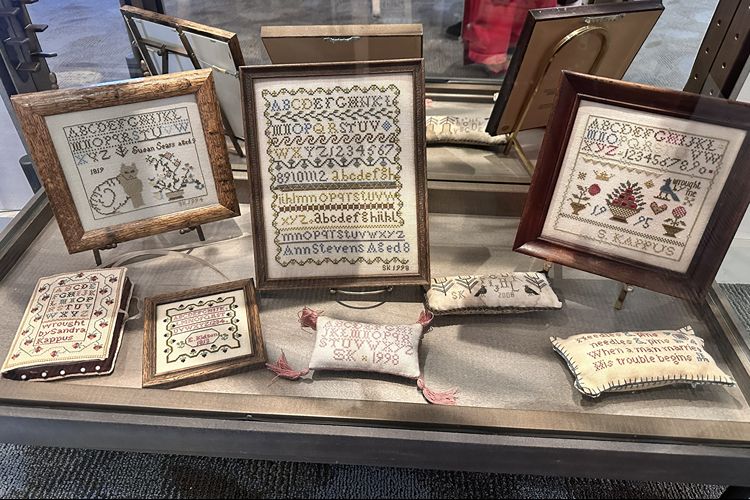
Sandy started the Sampler Guild of the Rockies out of a personal fascination with samplers, which were how girls in England used to be taught embroidery and the alphabet. Even though girls often didn’t attend school in the 17-19th centuries, they were encouraged to complete stitched fabric pieces that demonstrated their embroidery, alphabetical, pictural, and basic spelling skills. Monogramming clothing allowed women to show which items belonged to them during village washings. Over time, the embroidery became increasingly detailed, and today many needlepoint artists create reproductions of those simple alphabetical and scriptural needlepoint pieces.
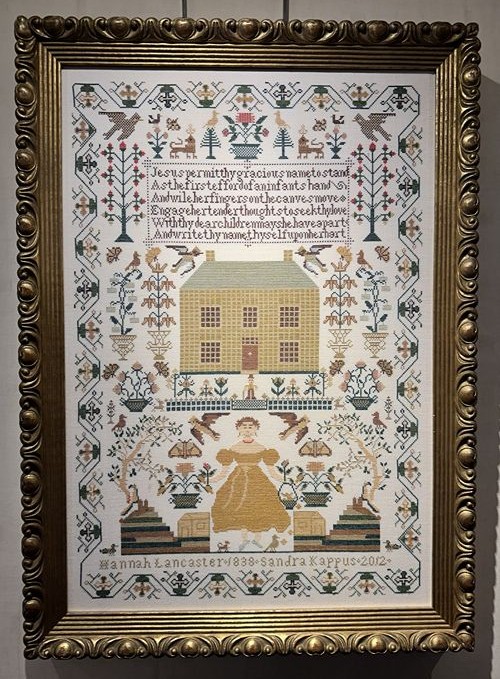 Quite a few of Sandy’s own pieces are samplers, including one of her favorites in the winter/spring Silverton Gallery exhibit featuring a lady and a large mansion home, made to commemorate her sister in law. “My husband is from Germany,” she explained, “and his sister’s name was Hannelore/Hannah, and the lady who designed this piece was also named Hannah [which you can see in the bottom left corner of the piece]. Hannah was a neat lady who worked for the United Nations and spoke many languages. If a child was injured, she would help act as translator.”
Today, there is a resurgence of interest in physical fabric arts. Sandy noted the impressive range of cloth and yarn options that are now available on the market.
“For years needlepoint was only made using wool thread, but now there are tons of options. That encouraged a resurgence for a while.” However, she has noticed that “what people want now are useful things,” she added. “Quilting is more popular because you can use a bedspread. After 9/11, the real resurgence was in knitting.” Needlepoint started to be used to decorate other art-related items. For instance, Sandy’s three dimensional needlepoint house on display was designed to hold sewing items, including a pin cushion and sewing scissors.
When she joined Holly Creek about a year ago, Sandy quickly joined the community’s knitting group “Warm Hearts, Warm Babies.”
“I love to do things for others. That’s why we’re here,” she shared.
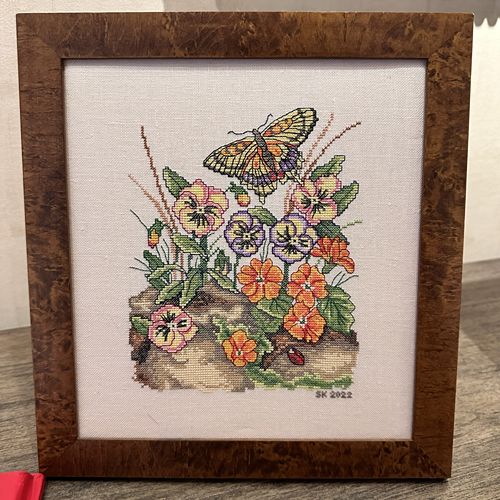
For Sandy, though, needlepoint will always hold a special place in her heart. “There are many people who consider it as needle art, and I like the artistic things that can be developed through needlepoint: all the different types of stitches.”
Sandy has many needlepoint pieces displayed in her home at Holly Creek, and many holiday and seasonal items that she didn’t include in the Silverton Art display, in part because many of them are now being enjoyed by her children. “90% of my Christmas items are with my kids. It’s fun to see how they display it, and in some cases, it looks much better than how I had the pieces arranged.”
When several members of the resident art group saw some of the needlework displayed in her new home, they encouraged her to participate in the community’s rotating art display.
“I heard that the display resurfaced memories of mothers, grandmothers and aunts for many others,” she shared. “Bringing back those joyful memories was the best part of all. I made people think about a happy time they had. It has helped create new connections too. In retrospect, I’m so glad I did it.”