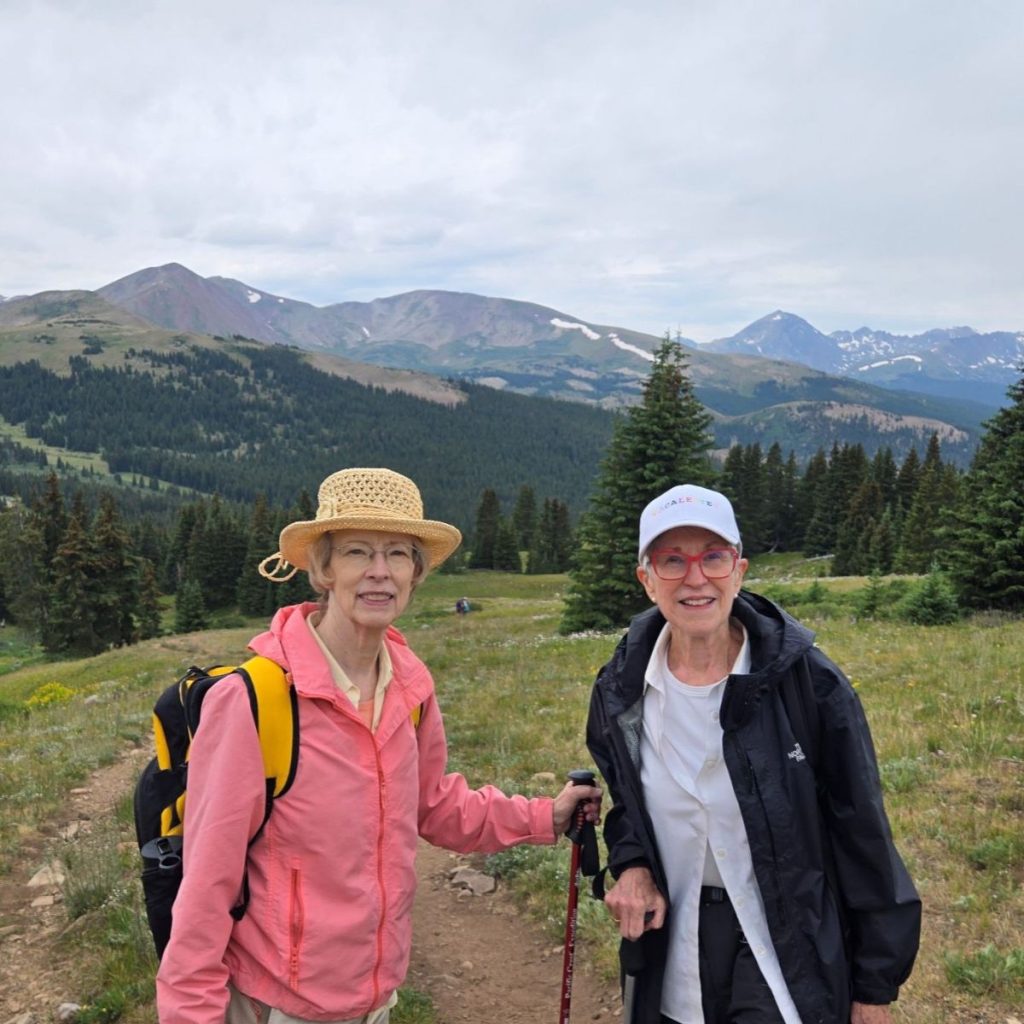

Connie Peterson and Barb Salomon moved to Holly Creek during the winter of 2025, and they bring with them a wealth of legal and judicial experience with decades of positive impact in their beloved Centennial State. Barb helped start the first women’s law firm in Denver and became one of the top family law mediators in the state. Connie served for fifteen years on the Denver District Court, with seven years as Chief Judge. But the paths that both women took to these achievements is perhaps as interesting as the successes themselves.
Connie’s Path to Becoming Chief Judge of the Denver District Court
While Connie was born and raised in Wisconsin, she quickly broadened her horizons after college by using her B.A. degree in history and political science with teaching certification to teach American military kids in Turkey and Spain for the Department of Defense as her then-husband traveled with the Air Force. For several years she taught history, English and Canadian geography to seventh graders.
“I don’t know if they learned anything,” she said with a laugh, “But I did.” It was challenging because the students all came from different backgrounds and it was hard to teach them from any common ground.
“I thought about going back to college and getting a PhD in political science. We lived next door to the Base JAG (Judge Advocate General) officer, and he said, ‘Why don’t you go to law school? That way, you’ll have a doctorate degree. You can teach, you can do a lot of different things.’” The idea strung a chord with Connie who, “always thought being a lawyer would be really cool.”
She never did teach again. Instead, she started studying at the University of Colorado at 26, excited to move back to a state she’d stayed in briefly before at NORAD. “The draw was the climate and at that point, Denver was alive. It was moving forward, and I wanted to be a part of that.”
She began working as an intern at the district attorney’s office in Golden for law school credit, and she stayed on to become deputy district attorney working on water law. “I grew up near Lake Superior, and I’ve always liked water,” she explained. “I’m happiest when I’m on a boat.”
After opening her own private practice, she applied to a vacancy on the Denver District Court. In November, 1984, Connie was appointed to the court at 36, the youngest member at the time and one of the youngest ever appointed. She served fifteen years on the court and was also nominated in her eighth year by the Chief Justice of the Colorado Supreme Court to serve as its Chief Justice. She served in that capacity for the remaining seven years of her service, in addition to a role as Chief Judge of the Denver Juvenile Court.
During her time in District Court, Connie oversaw several landmark cases, including the first death sentence verdict in many decades (the guilty party died in prison before serving his sentence). She also made it a mission to teach her fellow judges how to arrive at timely decisions.
“As a judge, one of the worst things you can do is not make a timely decision,” she explained. “Once you’ve issued a decision, the parties involved have an opportunity to either appeal, live with it or work it out between themselves.”
She also oversaw interesting water-related cases, including one that involved the Glenwood Springs Hot Springs. After she left the bench, Connie worked for a large Denver law firm and finally, as a private arbitrator.
As someone who has been watching Colorado’s water scene for decades, Connie urges the next generation of Coloradans to think about how they are using water. This is especially important as Colorado enters its driest water year on record.
For one, “Get rid of the golf courses,” she suggests. Barb – who loves golfing – disagrees but supports the underlying sentiment: that creative options are needed now more than ever. “The West was never designed climate-wise to sustain this many people living together.”
Barb’s Career-Long Advocacy for Women
Barb shares Connie’s love for the outdoors and water, having grown up across the bay from San Francisco and working as a whitewater river guide before she studied anthropology at Stanford and then law at the University of California, Berkeley.
“I realized that I am by nature an observer, but I needed to be in a role that was also more active. Anthropology has always been a great tool for me because I understand the culture and community,” she explained. But law gave her the opportunity to make a good living and “leave the world a little bit better place.”
Barb came to Colorado “for the mountains” and thanks to connections to Colorado-based Holland and Hart, which had “civil rights front and center of what they were doing on a volunteer basis.” Plus, they also happened to have an office in Aspen.
Connie and Barb met in 1979 through the Colorado Women’s Bar Association. It was a time of great growth and opportunity for women in Colorado’s legal scene, but there was still need for a professional organization to help them promote their work, volunteer and connect. Connie served as its third president, and Barb as its eleventh. Barb volunteered for years on the Thursday Night Bar, a volunteer call-in for legal questions. She answered hundreds of questions for people who were “having trouble paying their bills, getting along in their relationships, trying not to lose their kids.” It was “the law side of counseling,” an area that she was excelling in professionally as well.
Following her time with Holland and Hart, she and several colleagues started the first women’s law firm in Denver: Donnell, Davis and Salomon. They were together for five years and received a lot of family law cases. “At that time,” Barb explained, “that was the primary kind of work that women got. Our partner who was a big trial lawyer was disappointed, but I was really good at it. That ultimately resulted in my specialty in family law.”
In Connie’s own words, “Barb was the #1 divorce lawyer in Colorado.”
Barb is proud of her work helping advocate for women dealing with domestic violence and for law enforcement to treat it as a crime, including her work as the first President of Project Safeguard, which still exists today. When she first started her career, she thought that the most important work she would do was to help create due process rights for convicts in Cañon City when they were going to be disciplined. However, “at the end of the day, it was the individual cases, the opportunity to help wonderful people who were going through the difficult process of breaking up their marriages.”
Barb worked as a partner/council in small Colorado firms for 20-25 years, followed by ten years of legal mediations.
Sharing Wisdom for the Next Generation of Coloardo Women
This Women’s History Month, Connie and Barb have some simple advice for the next generation of Colorado women as they look for ways to make a difference in their state.
Reflecting on decades of experience and thousands of cases, Barb noted that “your word, your honesty, is everything. If a judge trusts that what you are saying is true, and it’s always true, that goes a long way. That, as well as gratitude and courage. What difference is it going make if you if you don’t speak up? Have the courage to speak.”
“Work hard, too,” Connie added, “And play hard. Above all, be kind.”
Living Well at Holly Creek
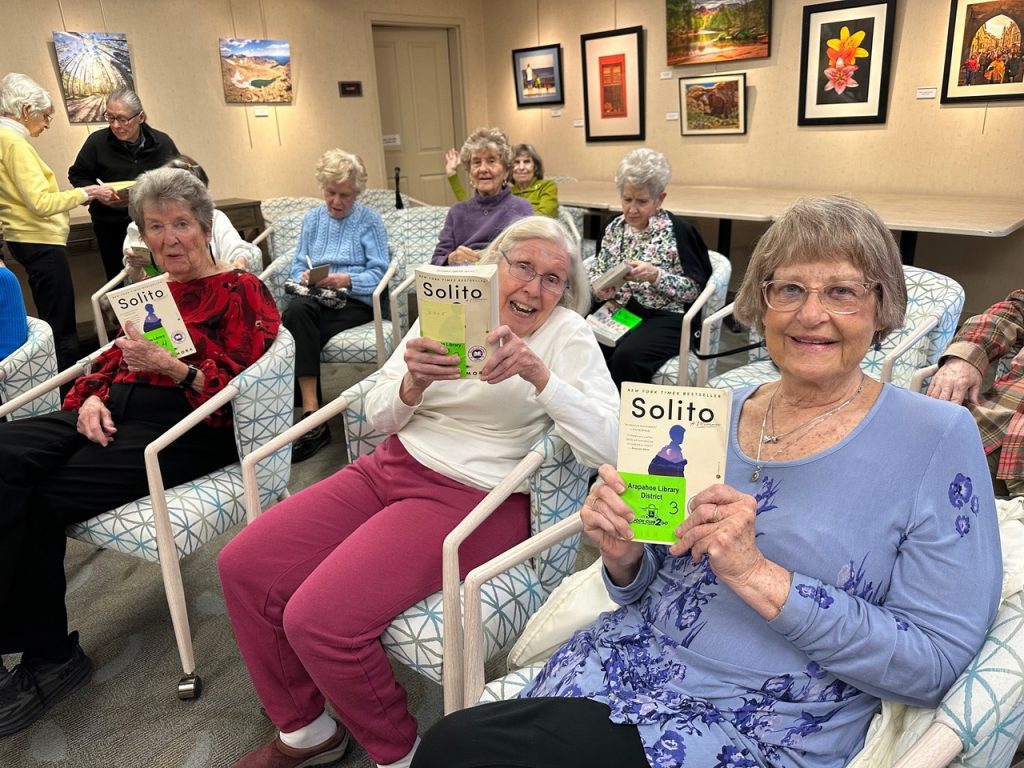
At Holly Creek, both Barb and Connie have already been impressed by the kindness and the ethic of their own neighbors.
“The people are still really involved with their Colorado activities. There are lots of outdoorsy people. So this place has already exceeded expectation.”
Now fully retired, Barb and Connie chose Holly Creek by following friend and current neighbor Phoebe Busch and because of its values and status as a non-profit. They are glad for a chance to stay active in community after their legal and judicial careers.
In Barb’s words, “both of us are so really grateful for what the law did for us, and hopefully, we also left it a better place.”